
There are three real paths to a data analytics certification: self-paced online platforms like Coursera, IBM, and Microsoft, government-recognized classroom institutes in Dubai, or corporate-partnered programs backed by names like KPMG and IBM that build the training around your actual organization’s data. Which one is right for you depends mostly on whether you’re certifying yourself individually or building capability across a team.
At , we deliver data analytics certification in Dubai through our partnership with Imarticus Learning, trusted by 65% of the world’s Fortune 500 companies for technology training, giving access to KPMG and IBM co-branded programs rather than a generic course. This guide breaks down where these certifications actually come from and how to choose between them.
Self-Paced Online Platforms:
Global platforms like Coursera, IBM, and Microsoft Learn offer some of the most accessible data analytics certifications available, covering SQL, Python, data visualization, and statistical analysis at your own pace. These are a strong starting point for individuals exploring the field or building foundational skills without committing to a fixed schedule. The trade-off is that you’re working with generic sample datasets and generic career guidance, not training scoped to your specific industry or role.
Local KHDA-Approved Institutes in Dubai:
Several Dubai-based training providers offer KHDA-approved, CPD-accredited data analytics courses combining SQL, Python, and Power BI dashboard creation with real-world capstone projects. These programs typically run 60 or more structured hours and lead to a locally and internationally recognized certificate, positioned for roles like Business Intelligence Analyst or Junior Data Scientist. Dubai’s D33 Agenda and continued growth in data roles have made this a genuinely active local training market, so it’s worth comparing a few providers on curriculum depth and instructor experience rather than assuming they’re interchangeable.
Corporate-Partnered Certification Programs:
This is the path built specifically for teams and organizations rather than individual career-switchers. Through our partnership with Imarticus Learning, Imperium Middle East connects UAE organizations with co-branded programs including Data Science with KPMG and Machine Learning and Deep Learning with IBM, backed by recognized names and built around real industry case studies rather than generic exercises. Imarticus also runs an Analytics Centre of Excellence with KPMG, which includes co-branded seminars, industry roundtables, and a Data Science Project competition where winning participants earn a KPMG-branded certificate.
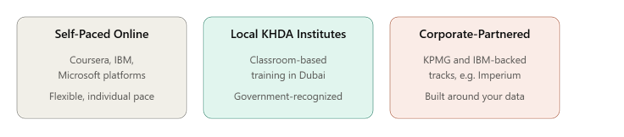
Comparing the Three Paths:
| Self-paced online | Local KHDA institutes | Corporate-partnered (e.g. Imperium) | |
|---|---|---|---|
| Best for | Individuals, flexible pace | Individuals wanting classroom structure | Teams and organizations |
| Data used | Generic sample datasets | Real-world capstone projects | Your organization’s own data environment |
| Recognition | Platform-specific (Coursera, IBM, etc.) | KHDA-approved, CPD-accredited | Co-branded with KPMG, IBM via Imarticus |
| Career support | Limited, self-directed | Structured, career-role focused | Built into organizational upskilling goals |
What to Actually Check Before Enrolling:
Not every certificate carries the same weight with employers. Before committing to any program, worth confirming: is the certifying body recognized in your industry (KPMG, IBM, and Microsoft carry more direct hiring signal than an unbranded course certificate)? Does the program include real projects and datasets, or purely theoretical modules? And does the curriculum map to an actual career path, Business Intelligence Analyst, Data Analyst, Analytics Consultant, rather than a generic “data analytics” label?
Why Organizations Choose the Corporate-Partnered Path:
Individual certification proves personal capability. Organizational certification programs solve a different problem: getting an entire team, often across multiple departments, to a consistent, applicable skill level using tools and data they’ll actually use on the job. This is the gap Imperium is built to close, connecting UAE organizations with KPMG and IBM-backed analytics programs delivered through Imarticus, rather than sending each employee off to a different individual course with inconsistent outcomes.
A Detail Worth Knowing: Certification vs Applied Skill:
A certificate proves you completed a program. What actually changes how a team works is whether the training was built around real data and real reporting problems. Programs using an organization’s own data, appropriately anonymized where needed, consistently produce more immediately applicable skills than ones built entirely on generic textbook datasets, regardless of which body issued the certificate.

Get Data Analytics Certification With Imperium Middle East:
Whether you’re building capability for a single department or rolling out a data analytics certification program across your organization, our team can scope a KPMG or IBM-backed track through our Imarticus Learning partnership to fit your people and your data environment. Get in touch with Imperium Middle East to start the conversation.
FAQs
1. What’s the difference between an online certification and a corporate-partnered program?
Online certifications use generic sample data and are self-paced, while corporate-partnered programs are built around an organization’s actual data environment and delivered to teams, often backed by recognized names like KPMG or IBM.
2. Are KHDA-approved data analytics courses in Dubai recognized internationally?
Many are also CPD UK-accredited alongside KHDA approval, giving them recognition both locally and internationally, though it’s worth confirming the specific accreditation for any program you’re considering.
3. Is a data analytics certification worth it without a technical background?
Yes. Most structured programs, including foundational tracks, are designed for learners without a prior technical background, building up from core concepts before introducing tools like SQL, Python, and Power BI.
4. What roles can a data analytics certification lead to?
Common roles include Business Intelligence Analyst, Data Analyst, Analytics Consultant, and Junior Data Scientist, spanning industries like finance, healthcare, e-commerce, and logistics.
5. Why choose a KPMG or IBM co-branded program over a generic course?
Co-branded programs carry stronger recognition with employers and typically include access to industry case studies, expert-led content, and, in some cases, project competitions with an added credential.