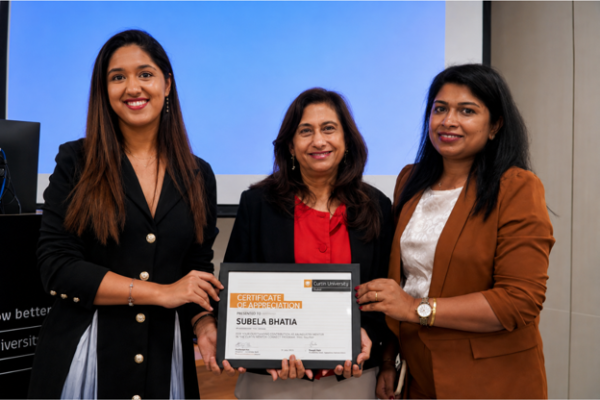
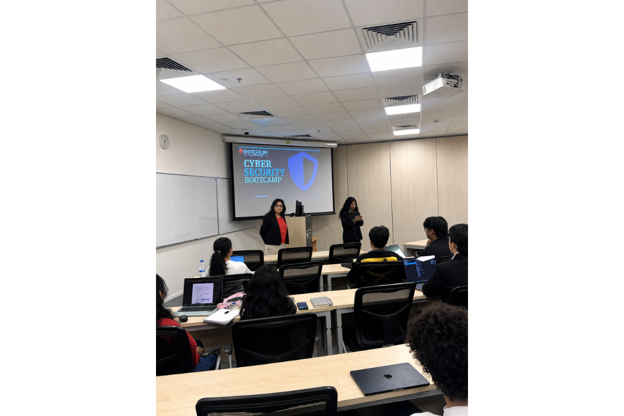
A room full of university students asking sharp, specific questions about penetration testing careers and AI-driven threats is not what most people picture when they think of a campus bootcamp. That was the room at Curtin University Dubai’s Cybersecurity Bootcamp 2026, where Imperium Middle East had the opportunity to speak directly with a generation that is already thinking seriously about cybersecurity as a career, not just a buzzword.
At Imperium Middle East, we deliver cybersecurity solutions and cybersecurity certification training across the UAE and the wider Middle East, working with enterprises and individuals who need real, employer-recognized skills rather than theory alone. Being invited into a room of Gen Z students changes the conversation slightly, but the fundamentals stay the same: where the industry is heading, what it takes to break in, and how the right credential turns interest into a career. This is what we covered.
Inside the Curtin Dubai Cybersecurity Bootcamp
Curtin University Dubai’s Cybersecurity Bootcamp brings together university students exploring a move into IT and cybersecurity for a week of hands-on workshops, industry sessions, and a closing competition that puts the week’s learning to the test. Our session focused on four areas that come up constantly in conversations with students and early-career professionals:
- Cybersecurity as a career path
- Current industry trends and opportunities
- Certifications for aspiring cybersecurity professionals
- Essential soft skills and technical skills required for success in the field
We’re grateful to Dr. Benita Christopher, Chithirai Pon Selvan, and Bhavika Khetani for the invitation, and to Curtin University Dubai and the Cybersecurity Advisors Network (CyAN) for building a platform where industry and academia can meet students at exactly the point where career decisions start to take shape.
Cybersecurity as a Career Path: Real Demand, Real Competition
The honest starting point for any student is that cybersecurity is both wide open and increasingly competitive at the same time. Global reporting points to well over 500,000 unfilled cybersecurity roles in the United States alone, and the shortage is a familiar story across the Middle East as regional digital transformation accelerates. At the same time, entry-level roles have gotten more crowded as more students graduate into the field, with some entry-level positions seeing significantly more applicants than openings.
That combination matters for how a student should approach the field. Broad enthusiasm for cybersecurity is not enough on its own anymore. What separates candidates who land their first role from those who don’t is demonstrated, verifiable skill, built through hands-on labs, real credentials, and practical experience, not just interest or a degree on its own. This is exactly where structured cybersecurity certification training earns its place early in a student’s plan rather than as an afterthought post-graduation.
Current Industry Trends and Opportunities
Three shifts came up repeatedly in the session, and all three are shaping hiring decisions right now.
AI is changing both the attack surface and the defense: Employees are increasingly using AI tools without security team approval, often called shadow AI, and it’s creating new categories of data exposure that didn’t exist two years ago. On the defensive side, AI-integrated skills are now built directly into leading certifications, meaning students entering the field today need AI literacy from day one, not as a later specialization.
Cloud security demand keeps climbing: As organizations across the region migrate more infrastructure to the cloud, cloud-specific skills and credentials have become some of the fastest-growing areas of demand, often commanding a premium over generalist security roles.
Specialization pays, but foundations still matter: Roles like penetration testing and security architecture see far less applicant competition than generalist entry-level roles, which makes specialization an attractive long-term path. But every specialist path still starts with foundational cybersecurity knowledge, which is exactly why we walk students through a realistic sequence rather than encouraging them to chase an advanced credential too early.
Certifications for Aspiring Cybersecurity Professionals
Certifications came up more than any other topic in the room, and for good reason. Over 75% of 2026 cybersecurity job postings list at least one certification as required or preferred, and industry research shows a large share of employers now favor certified candidates for both client-facing and internal security roles. For students and early-career professionals, the right cybersecurity certification training doesn’t just teach content; it signals to hiring managers that a candidate can perform, not just recite.
The table below reflects the general shape of a realistic certification path, from a student’s first credential through to advanced specialization.
| Career Stage | Certification Type | Focus | Typical Next Step |
|---|---|---|---|
| Getting started | Foundational security certification (e.g., Security+ equivalent) | Core security concepts, networking basics | Build hands-on lab experience |
| Early career | Certified Ethical Hacker (CEH) | Ethical hacking across all five phases of attack and defense, AI-integrated skills | Specialize or move into an analyst/SOC role |
| Specializing | Certified Penetration Testing Professional (CPENT) | 100% practical, advanced offensive security testing | Red team, penetration testing, or AI security roles |
| Leadership track | Governance, risk, and compliance credentials | Security strategy, policy, and organizational risk | Security management or CISO-track roles |
A fun fact that surprised more than a few students in the room: CEH has been the world’s leading ethical hacking certification for over 20 years and is mapped to 49 distinct cybersecurity job roles, which means one credential can open far more doors than students often assume when they first look at a certification list.
We also talked candidly about sequencing. Advanced, fully practical certifications like CPENT reward hands-on experience students haven’t built yet, so the right cybersecurity certification training path usually starts with foundational, broadly recognized credentials before moving toward specialist or leadership-track certifications.
Essential Soft Skills and Technical Skills Required for Success
Technical skill gets a student in the door. What keeps them there, and moves them up, is a combination the students in the room hadn’t fully considered yet.
On the technical side, the fundamentals still carry the most weight: networking, operating systems, and core security concepts, followed by cloud security, scripting for automation, and threat detection. These form the base that every certification and every specialization builds on.
On the soft skills side, the sessions consistently point to the same short list: clear communication with both technical and non-technical stakeholders, critical thinking under pressure, adaptability as tools and threats change constantly, and collaboration across security, IT, and business teams. A security analyst who can identify a vulnerability but can’t explain its business impact to a non-technical manager is only doing half the job. That’s a point we made directly to the students, since it’s often the gap between a good technical candidate and one who actually gets hired.
Frequently asked questions
1. What is the best cybersecurity certification for a student just starting?
2. Do you need a university degree to work in cybersecurity?
3. How long does it typically take to become job-ready in cybersecurity?
4. Why do soft skills matter in a technical field like cybersecurity?
5. Does Imperium Middle East offer cybersecurity certification training for students and early-career professionals, not just enterprises?
Looking Ahead
Sessions like this one are exactly why industry-academia collaboration matters. Students walked away from Curtin University Dubai’s Cybersecurity Bootcamp with a clearer picture of what a cybersecurity career actually requires, and we walked away encouraged by how seriously this generation is already engaging with the field.
If you’re a student, parent, or educator thinking about the right next step into cybersecurity, or an organization looking to build this kind of talent pipeline internally, Imperium Middle East’s cybersecurity certification training connects individuals and teams with globally recognized credentials built around real-world outcomes.
Get in touch with the Imperium team to talk through the right certification path for your goals.